Blog
Defending the power of our states since 2009

I founded Save Our States in 2009 to oppose the National Popular Vote interstate compact (NPV). I believe the Electoral College forces party coalitions to be more national and inclusive, allows states to remain in charge of elections, and most often increases the legitimacy of winners. I also believe that the NPV plan to manipulate the Electoral College is uniquely foolish and dangerous.
One of the godfathers of NPV seems to agree. Actually, at least two of the three law professors who suggested the concept behind NPV have expressed doubts about the actual compact.
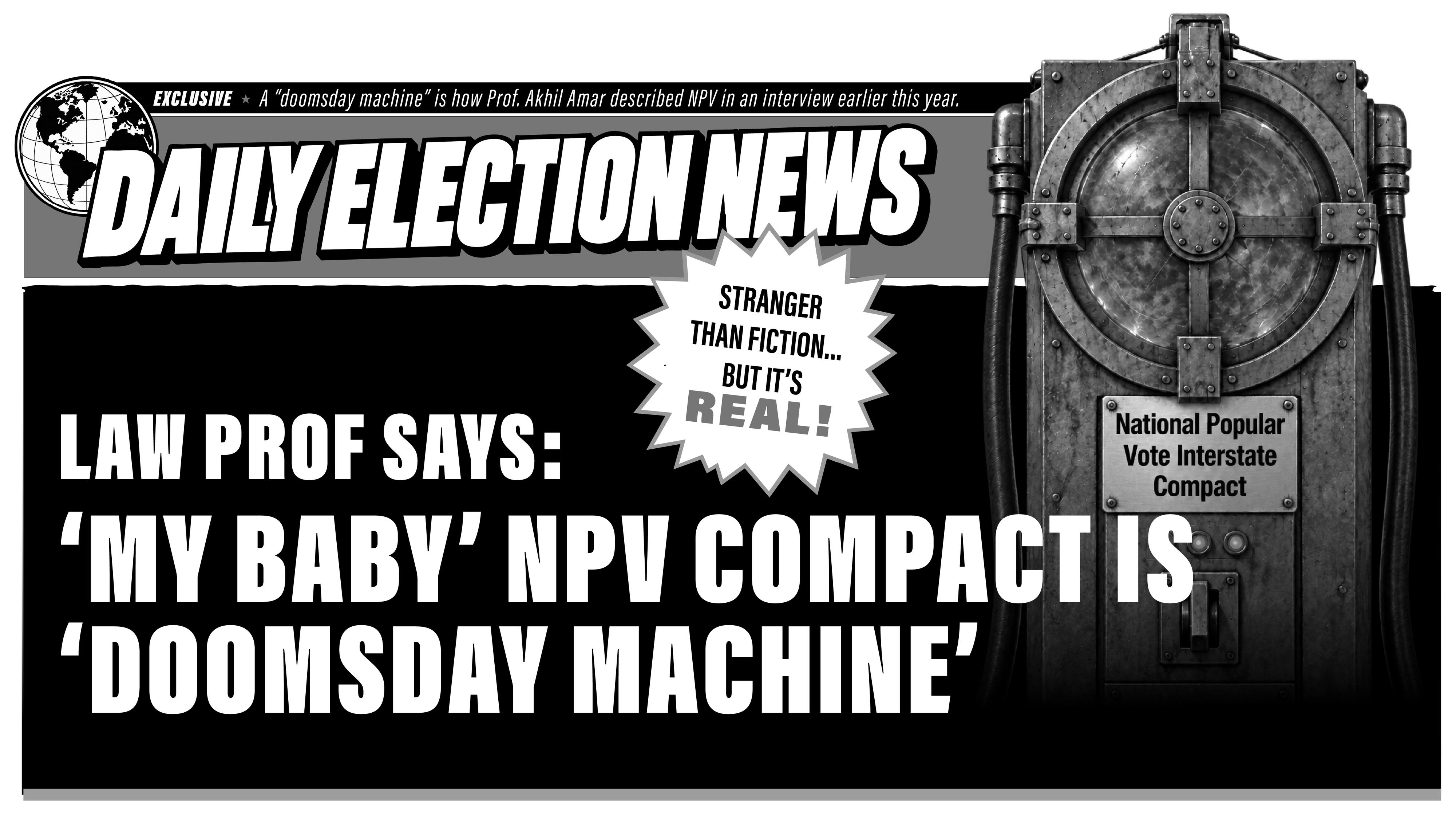
A “doomsday machine” is how Prof. Akhil Amar described NPV in an interview earlier this year. He also referred to the idea as “my baby,” because he and his brother, fellow law professor Vikram Amar, described it (among other ideas) in a 2001 article. Even there, the professors recognized a fundamental danger: there is no “national popular vote.” Today’s campaign for the compact is misleading, with lobbyists preferring that state legislators—who decide whether or not their state will join NPV—not look under the hood.
The compact relies on each NPV state’s “chief election official” to determine vote totals from other states, add them up, and determine a winner. Ignored is the fact that official vote totals often differ and may not be available in time. Also ignored are differences in state laws and procedures, especially for challenges and recounts. Finally, the compact assumes other states will simply go along rather than looking for ways to thwart NPV.
In 2001, the Amar brothers raised many of these issues.
Of course, any coordinated state-law effort would require specifying key issues: Majority rule or plurality rule? Runoff or no? How should recounts and challenges be handled?
It would be hard to rely completely on the laws and courts of each state, many of which might not be part of the cooperating 270 group. For example, the national vote might be close even though the state vote in some noncooperating state was not, and that state might refuse to allow a state recount. Indeed, a noncooperating state might theoretically try to sabotage the system by refusing to allow its citizens to vote for president! What if some state let 17 year-olds vote in an effort to count for more than its fair share of the national total? And what about Americans who live abroad or in the federal territories?
John Koza, the computer scientist and lottery inventor who created the compact and funds the NPV campaign, seems to ignore all these concerns. He and his lobbyists sometimes claim that future elections are unlikely to be close and that state officials will ignore partisan politics.
Perhaps they haven’t noticed that big-city Democrats are the most fervent advocates for NPV? Or maybe Koza fails to understand the partisan motivations behind such support? Koza himself is a major donor to far-left candidates who launched NPV after serving as one of California’s presidential electors for Al Gore.
Even the Vox article—the one that quotes Akhil Amar—recognizes that with NPV, Democrats could set off a new battle over presidential election rules.
Imagine the national popular vote goes into effect for 2028 and Democrats win the White House — and the GOP wins the 2030 midterms in a red wave soon afterward. New GOP majorities in swing states could back out of the compact — but they could also come up with worse reprisals. From their perspective, Democrats will have set a new norm that the party controlling swing state governments can completely rewrite the presidential election rules before the election for partisan gain.
Partisan gamesmanship is one more reason to see NPV as a “doomsday machine,” especially when combined with changing and uncertain rules and new kinds of legal conflicts. Whether a person supports or opposes the Electoral College, the dangers of Koza’s NPV compact plan offer something much worse than the status quo.