Blog
Defending the power of our states since 2009

My colleague Trent England recently explained how the National Popular Vote interstate compact (NPV) has a serious problem with Ranked Choice Voting (and math). He used a fictional election for fifth-grade class president to show that you can’t easily and fairly combine vote totals from classrooms (states) using RCV.
I thought I’d use Trent’s framework to illustrate additional problems with trying to add together vote totals cast, counted, and reported in very different ways, this time using a sixth-grade class president election, also held across five classrooms with 20 students each, where once again the principal has left it up to each teacher to decide the rules of the election in his or her classroom.
The election has three candidates:
- Richie, running on “free ice cream,”
- Joanie, campaigning for “abolish homework,” and
- Arthur, promising “extra recess time.”
Each teacher has opted to run their election differently.
- Mr. Leonard isn’t really into student government. His class will vote only at lunch on election day, absent students won’t get to vote, write-ins are allowed, and students with missing assignments aren’t allowed to vote
- Ms. Shirley really loves student government. Any of her students who will be absent on election day can cast votes in advance, or text her their vote by election day, write-ins are not allowed, and everyone is required to vote. She also allows parents to cast votes (only 2 do – the parents of Chuck, Richie’s twin brother)
- Mr. Carmine has both Joanie and Arthur in his class and uses ‘Approval Voting,’ allowing students to cast one vote for each candidate they approve of, and write-ins are allowed
- Mr. Andrew has Richie in his class, and picks ‘Unit Voting’ for his classroom, allowing the majority of students to determine how all twenty votes will be reported (Richie wins classroom vote 10-8-2, with Joanie the runner-up), and write-ins are not allowed
- Ms. Laverne doesn’t want the election to be a popularity contest, so her students are to vote for “free ice cream,” “abolish homework,” or “extra recess time,” not any named candidate, and write-ins are not allowed
The principal receives the following vote totals from the five classrooms:
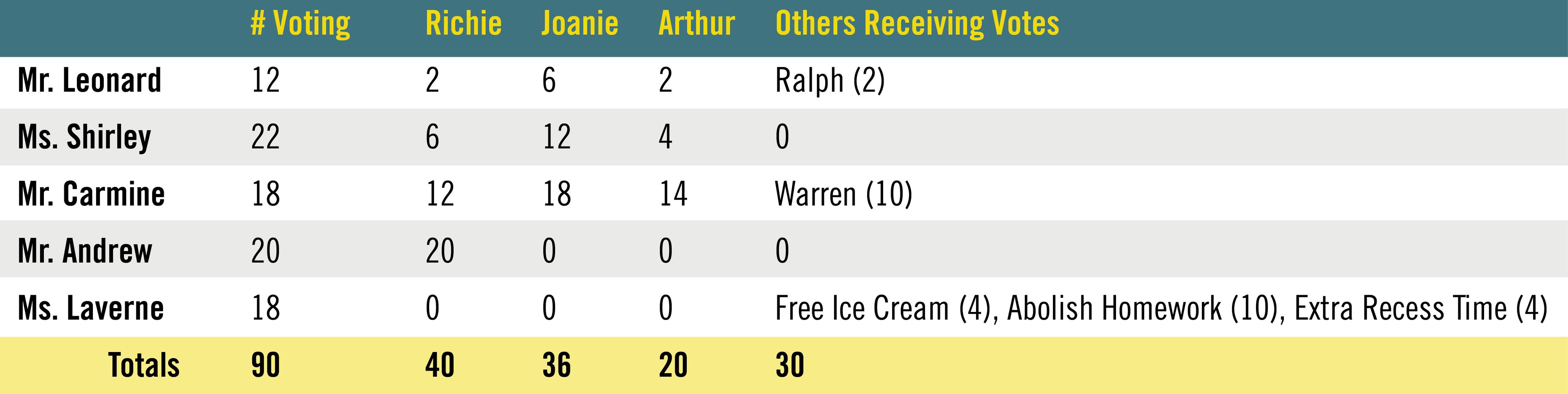
It’s obvious to the principal that Joanie is the candidate with the most support – she (or her platform) won four of five classrooms (including receiving the most Approval votes in Mr. Carmine’s class), and if all the teachers had run normal elections she almost certainly would have received more popular votes than Richie. But with each classroom free to run its election however it wants, Richie is the winner after receiving 40 out of the 126 reported votes cast by 88 students (and two parents).
A principal seeing nonsensical results like these would immediately realize the problem and probably just toss out the results and order a new election with clearer, more uniform rules. And even if they didn’t and Richie was declared the winner, it’s really not that big of a deal – it is just an election for sixth grade class president, and it’s not exactly a crisis if the less-popular “free ice cream” candidate prevails over the more-popular “abolish homework” candidate.
The same cannot be said, of course, of an election for President of the United States under the National Popular Vote interstate compact. The difficulties with trying to add vote totals from states using very different election processes would trigger at best a massive controversy over the fairness and outcome of the presidential election. In a close election, it would all but guarantee a constitutional crisis.
As Professor Vikram Amar, one of the law professors who helped develop the concept of NPV once explained, “…there is substantial nonuniformity among the states … on the questions of who votes, how votes are cast, and how votes are counted and recounted. This lack of uniformity undermines the normative appeal of the move to a national popular vote and also raises the specter of electoral crises….”
Exactly right. It’s obviously a bad idea to try to elect a fifth- or sixth-grade class president with votes that are cast, counted, and reported very differently. Why on earth would we do it for President of the United States?