Blog
Defending the power of our states since 2009

In 2006, when John Koza launched the campaign for his National Popular Vote interstate compact (NPV), no states used—or were considering using—ranked-choice voting (RCV) in presidential elections. This led to a blind spot in the compact, which leaves it to an election official in each NPV state to determine which vote totals to use from other states.
RCV produces different totals at each step in the process, shifting votes from one candidate to another and deleting some votes and voters altogether. Originally, Koza admitted, “it’s not clear how to combine” votes from RCV states. More recently, he and his campaign have taken the position that only final-round RCV totals can be used—which leads to mathematical nonsense.
The simple illustration below shows how a candidate who would win with either an electoral college or direct election would lose under “Koza’s rules.”
Three candidates are running for fifth-grade class president. There are five classrooms, each with 20 students. Among all the students, 51 voted for Suzie. She also won majorities in three classrooms.
Did she win? No, because they used “Koza’s rules,” combining ranked-choice voting results from two classrooms with votes from the other three classrooms to create a “fifth-grade popular vote.”
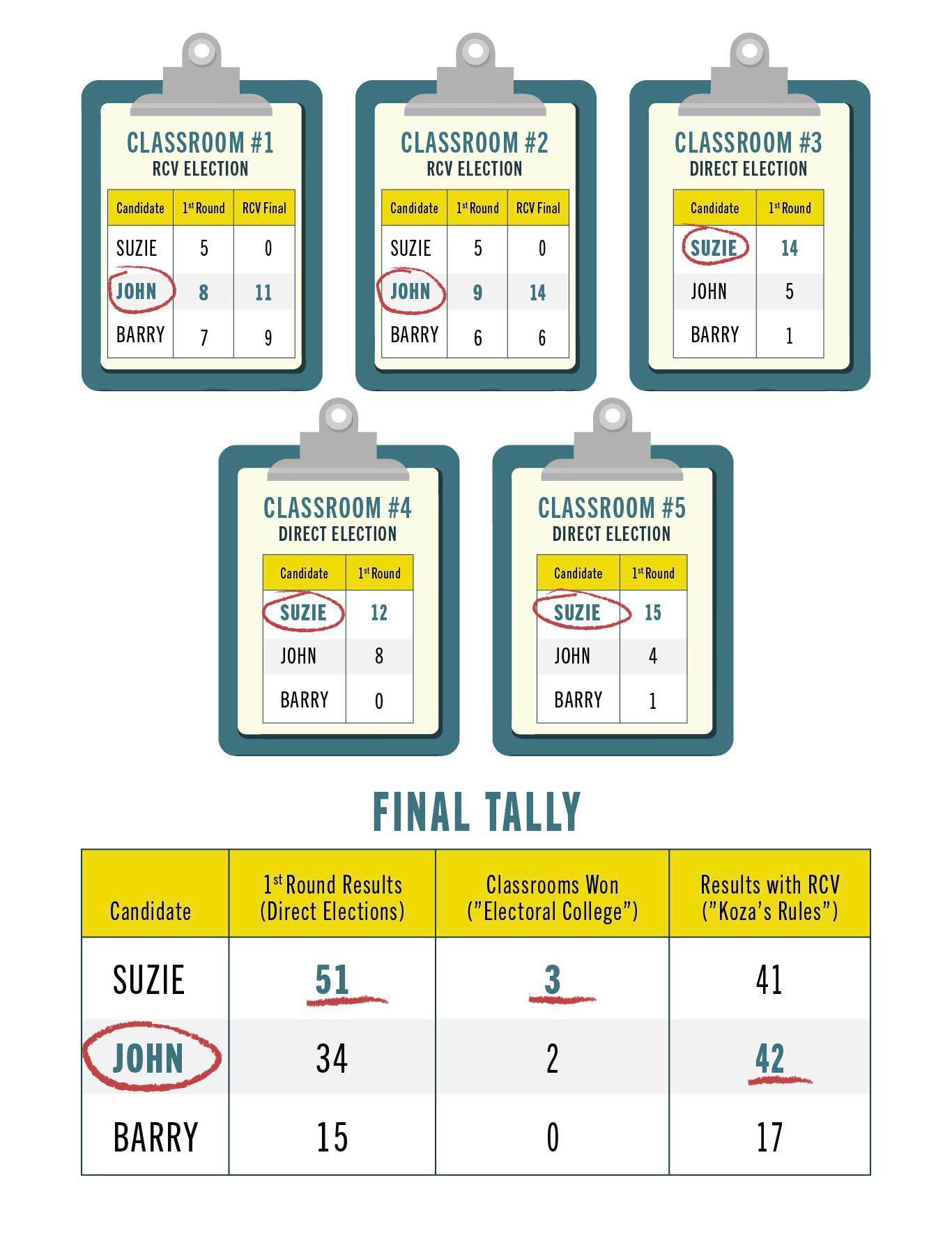
In the two RCV classrooms, Suzie received first-choice votes from 10 students. But because she came in third in those classrooms, RCV eliminated those votes and shifted eight to John and two to Barry. That ten-vote change dropped her from 51 votes—a majority of all 5th graders—to just 41 votes.
In a direct election (the equivalent of the first-round results), Suzie wins. If they used a classroom-based system (an electoral college), Suzie wins. Only under “Koza’s rules,” where RCV results are aggregated together, would Suzie lose and John win.
It is important to note that no organization advocating ranked-choice voting claims that you can generate local RCV results (at the precinct level, here within classrooms, or at the state level in a national direct election) and then combine final-round data to determine a valid result. On the contrary, they all indicate that ballot data must be centralized prior to the RCV process.
There is no mathematical validity to Koza’s rules, which would have NPV compact states combine state-based, final-round RCV data to determine a “national popular vote.” It is simply not math, and thus not democratic in any sense.
It is also worth noting that the NPV compact does not require “Koza’s rules.” It would at least be mathematically valid to ignore RCV tabulation and use first-round data to calculate a nationwide popular vote. It appears that this solution was rejected because some RCV-supporting politicians in Maine didn’t like the optics: After pushing RCV into Maine, they insisted that it must continue to be used even if NPV takes effect—and that NPV states must accept their final-round RCV results.
The problem for Koza is twofold. One is that he needed these Maine legislators to enact NPV there and needs them to prevent its repeal (which came within a single vote in 2025). The other is that he cannot admit what is plain in the text of his compact: that one official in each NPV state would determine the vote totals from every other state, including where states produce different or ambiguous totals and those decisions could alter the outcome of a close election.
Here is one final fact. In the classroom example, the principle did not dictate which election system was used in the classrooms. In our federal system, election rules are likewise left mostly to state governments. This is why Alaska and Maine can use RCV to choose presidential electors and other state officials. It is also why even some law professors who dislike the Electoral College know that Koza’s compact is dangerous.